
Brazilian Jiu-Jitsu guide
7 pieces of advice for starting your BJJ journey
What our coaches wish every new grappler knew in their first months on the mat, from tapping to belts.
Brazilian Jiu-Jitsu is one of the most rewarding martial arts you can start, and one of the most humbling. The first few months can feel like a puzzle where everyone else has the picture on the box. These seven pieces of advice will help you enjoy the process, stay safe and improve faster.
Tap early, tap often
Tapping is how Jiu-Jitsu stays safe enough to train hard every week. A tap simply means "you got me, let's go again". Nobody remembers who tapped in training, but an injury can keep you off the mat for months.
- Tap the moment you feel a submission is locked in, not when it starts to hurt.
- Tap with your hand on your partner or the mat, or say "tap" out loud if your hands are trapped.
- When your partner taps, let go straight away.
From the mat: Every black belt has tapped thousands of times. It is part of learning, not a sign of failure.
Learn to survive and escape first
In your first months you will spend a lot of time underneath people. Instead of fighting it, make defence your speciality. Good escapes from mount and side control give you a base that every other technique is built on.
- Learn the bridge (upa) and the shrimp (hip escape). You will use them in every roll.
- Keep your elbows tucked and protect your neck.
- Count a successful escape as a win, even if you never get on top.
From the mat: Beginners who learn to defend first usually progress faster later, because they stop panicking under pressure.
Know where you are
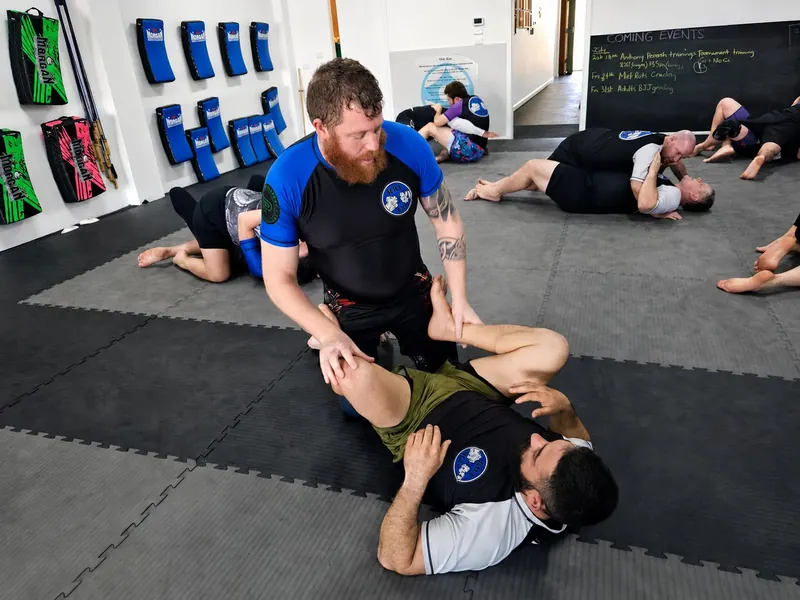
BJJ makes sense once you understand the main positions: guard, half guard, side control, mount and back control. Each one has a goal, whether you are on top or underneath. Knowing which position you are in tells you what to do next.
- Ask your coach what the goal is from each position you learn.
- During rolls, quietly name the position you are in.
- Focus on getting to good positions before chasing submissions.
From the mat: Position before submission. It is the oldest saying in Jiu-Jitsu for a reason.
Relax and breathe
New students often try to win every exchange with strength and are exhausted within a minute. Jiu-Jitsu rewards calm, efficient movement. Breathing slowly and only using strength when it counts lets you roll longer and think more clearly.
- Breathe out through your nose and mouth when you feel pressure on top of you.
- Use frames with your arms and legs instead of pushing with all your strength.
- Roll at 60 percent with new partners and save hard rounds for later.
From the mat: The calmest person on the mat usually wins, and is the one everyone wants to train with.
Drill as much as you roll
Rolling (live sparring) is fun, but techniques become automatic through repetition. Drilling with a cooperative partner lets you get the details right before trying them against resistance.
- Treat drilling time as seriously as rolling time.
- Pick one technique from class and drill it again before or after the next session.
- Ask a partner for five extra minutes of drilling. Most people will say yes.
From the mat: You will only use in a roll what you have drilled until it feels boring.
Be a clean, safe training partner
Jiu-Jitsu is close contact, so hygiene matters for everyone. Good habits stop skin infections and make you a partner people want to train with.
- Wear a freshly washed gi or rash guard every class, never one from yesterday.
- Keep finger and toe nails short.
- Wear thongs or shoes off the mat, and never walk on the mat in shoes.
- Cover cuts and stay home if you have a skin condition or are unwell.
From the mat: Clean gear and short nails are the first sign of a respectful training partner.
Be patient with belts
BJJ belts take longer than in most martial arts, often several years each. That is part of what makes them meaningful. Stripes and small breakthroughs mark progress along the way, and the only fair comparison is with yourself a few months ago.
- Notice small wins: surviving longer, escaping a position, landing a sweep for the first time.
- Train consistently. Turning up is what earns stripes and belts.
- Ask your coach what to focus on for your next stripe.
From the mat: Everyone who wears a black belt started as a white belt who simply kept turning up.
Ready to start?
Start your BJJ journey
Adult BJJ (14+) runs Monday 6pm Gi, Wednesday 6pm No Gi, Friday 6pm Gi Fundamentals and Saturday 10:30am No Gi Fundamentals. Kids train in Mat Monkeys (5–8) and Mat Rats (9–13). New students start with two weeks for $49.95.
Book a trial class ›By the instructors at Cirillo's RMA, 10 Probert Ave, Griffith NSW. Questions? Call 0427 630 488.